
The Top Uses of ChatGPT for E-commerce
Using ChatGPT for e-commerce works best when it supports repetitive, high-impact tasks that affect visibility, conversions, and customer experience.
Here is how you can use OpenAI models to help you promote your online retail products:
🛍️ High-level product copy
Create benefit-focused descriptions and merchandising angles.
🔎 SEO optimization
Generate keyword-rich metadata, category copy, FAQs, and internal linking ideas.
📧 Email marketing
Quickly draft welcome flows, promotional messages, and other email types.
💬 Customer support templates
Build consistent replies for any type of product question.
If you’re a store or business owner, instead of having writer's block, you can use GPT and other models like Claude to draft, refine, and grow content faster.
E-Commerce Prompts for High-Converting Product Descriptions
Below are some of the best ChatGPT prompts for e-commerce business products to help you turn raw product details into persuasive copy.
The feature-to-benefit translator
Turn technical specs or plain product details into benefits shoppers actually care about to avoid sounding too functional or manufacturer-written.
Prompt 🛒
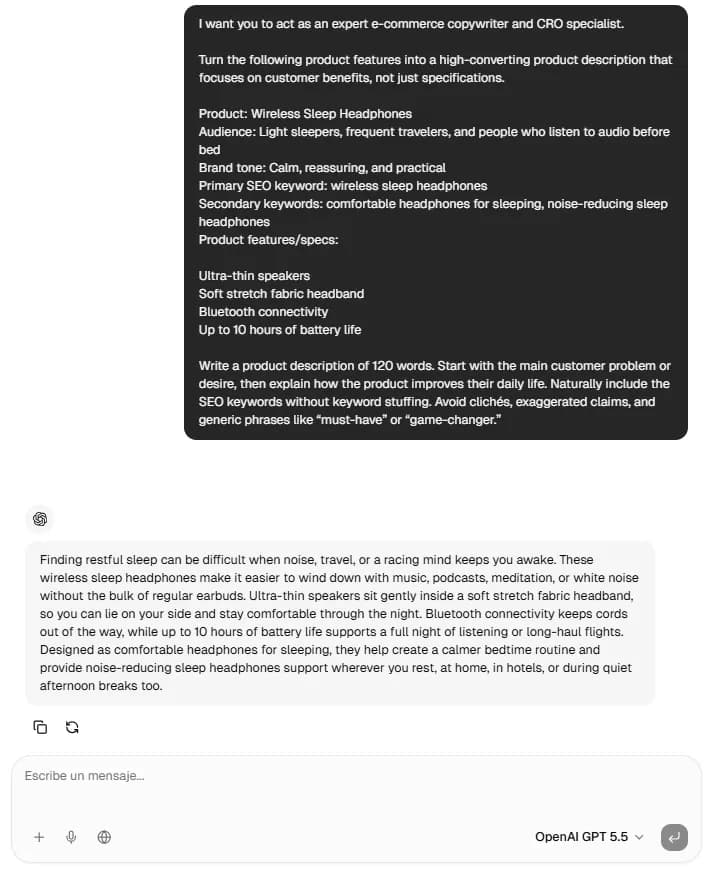
I want you to act as an expert e-commerce copywriter and CRO specialist.
Turn the following product features into a high-converting product description that focuses on customer benefits, not just specifications.
Product: [Product Name]
Audience: [Target Customer]
Brand tone: [Company Tone]
Primary SEO keyword: [Primary Keyword]
Secondary keywords: [Secondary Keywords]
Product features/specs:
[Feature 1]
[Feature 2]
[Feature 3]
[Feature 4]
Write a product description of [Word Count] words. Start with the main customer problem or desire, then explain how the product improves their daily life. Naturally include the SEO keywords without keyword stuffing. Avoid clichés, exaggerated claims, and generic phrases like “must-have” or “game-changer.”
Example in Lorka’s AI chat (GPT-5.5):


Try This Prompt in Lorka AI
Copy the feature-to-benefit translator prompt, choose your AI model, and generate polished content in one workspace.
Try This Prompt in Lorka AIThe sensory & story-driven description
Use this AI instruction for apparel, beauty, food, luxury items, gifts, or anything that sells through experience as much as function.
Prompt 🛒
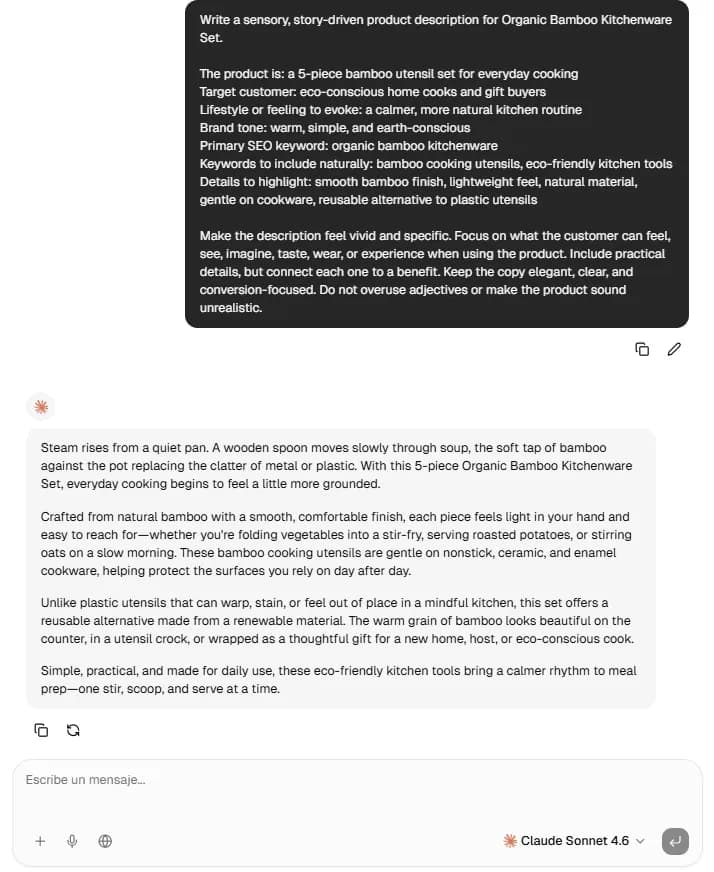
Write a sensory, story-driven product description for [Product Name].
The product is: [Brief Product Description]
Target customer: [Target Customer]
Lifestyle or feeling to evoke: [Desired Feeling or Lifestyle]
Brand tone: [Company Tone]
Primary SEO keyword: [Primary Keyword]
Keywords to include naturally: [Secondary Keywords]
Details to highlight: [Materials, Origin, Texture, Flavor, Fit, Craftsmanship, Use Case]
Make the description feel vivid and specific. Focus on what the customer can feel, see, imagine, taste, wear, or experience when using the product. Include practical details, but connect each one to a benefit. Keep the copy elegant, clear, and conversion-focused. Do not overuse adjectives or make the product sound unrealistic.
Example in Lorka’s AI chat (Sonnet 4.6):
Try This Prompt in Lorka AI
Copy the sensory & story-driven description prompt, choose your AI model, and generate polished content in one workspace.
Try This Prompt in Lorka AIThe “skimmer-friendly” bullet points
This e-commerce prompt helps create compelling bullets for shoppers who scan before they decide, for Shopify product pages, Amazon listings, landing pages, and more.
Prompt 🛒
Act as an e-commerce conversion copywriter.
Create skimmer-friendly product bullets for [Product Name] using the information below:
Product type: [Product Type]
Target customer: [Target Customer]
Primary SEO keyword: [Primary Keyword]
Secondary keywords: [Secondary Keywords]
Main features: [Feature List]
Main customer pain points: [Pain Points]
Purchase motivators: [Motivators: price, quality, convenience, durability, style, sustainability, speed, etc.]
Write [Number] bullet points. Each bullet should start with a clear benefit in bold, followed by one short explanation. Keep each bullet under [Word Limit] words. Make the copy easy to scan, specific, and focused on why the product is useful. Include SEO keywords naturally where they fit.
Try This Prompt in Lorka AI
Copy the skimmer-friendly bullet points prompt, choose your AI model, and generate polished content in one workspace.
Try This Prompt in Lorka AIChatGPT Prompts for E-commerce SEO & Metadata
To get your products noticed faster while spending less on ads, you can improve organic visibility with structured prompts for titles, metadata, category copy, and FAQs.
Bulk title & meta description generator
Generate SEO-optimized content at a high rate while keeping character limits under control.
Prompt 🛒
Act as an e-commerce SEO specialist and CRO copywriter. Create optimized SEO titles and meta descriptions for the following products: [Product List]. For each product, include the target keyword [Primary Keyword] and naturally include any relevant secondary keywords: [Secondary Keywords]. Keep each SEO title between [Character Range] characters and each meta description under [Character Limit] characters. Make the copy clear, specific, and click-worthy without sounding exaggerated. Focus on customer benefits, purchase intent, and what makes each product different. Return the results in a table with columns for Product, SEO Title, Meta Description, Primary Keyword, and Notes.
Try This Prompt in Lorka AI
Copy the bulk title & meta description generator prompt, choose your AI model, and generate polished content in one workspace.
Try This Prompt in Lorka AICategory page content writer
Create helpful collection intros that support SEO without keyword stuffing.
Prompt 🛒
You are an e-commerce SEO content strategist. Write an introduction for the category page [Category Name] on an online store that sells [Product Types]. The target customer is [Target Customer], and the brand tone is [Company Tone]. Naturally include the primary keyword [Primary Keyword] and the secondary keywords [Secondary Keywords]. The introduction should be [Word Count] words and explain what shoppers can find in this category, who the products are best for, and the main benefits of choosing them. Keep the copy useful, natural, and conversion-focused. Avoid repeating the same keyword too often or making unsupported claims.
Try This Prompt in Lorka AI
Copy the category page content writer prompt, choose your AI model, and generate polished content in one workspace.
Try This Prompt in Lorka AIProduct FAQ generator
Answer questions a shopper could typically have based on your product and capture more long-tail search demand.
Prompt 🛒
Act as an e-commerce SEO and customer support specialist. Analyze this product information: [Product Name, Description, Features, Materials, Size, Shipping Details, Return Policy, Use Cases]. Generate 5 common customer questions and concise answers for the product page. Focus on questions shoppers may search before buying, including sizing, compatibility, materials, care instructions, shipping, returns, durability, and use cases, where relevant. Naturally include the target keyword [Primary Keyword] and related terms [Secondary Keywords] where they fit. Each answer should be clear, reassuring, and under [Word Count] words. Do not invent details that are not included in the product information.
Try This Prompt in Lorka AI
Copy the product FAQ generator prompt, choose your AI model, and generate polished content in one workspace.
Try This Prompt in Lorka AIChatGPT E-Commerce Prompts for Email Marketing & Abandoned Carts
Quickly create email campaigns that recover sales and increase repeat purchases while also providing customer support.
The 3-Part abandoned cart sequence
Build a simple recovery flow using this ChatGPT e-commerce prompt with reminders and urgency.
Prompt 🛒
Act as an e-commerce email marketing strategist. Write a 3-email abandoned cart sequence for [Product or Product Category]. The target customer is [Target Customer], and the brand tone is [Company Tone]. The main purchase hesitation is likely [Customer Objection], and the strongest product benefits are [Key Benefits]. Include the primary keyword or phrase [Primary Keyword] naturally if it fits. Email 1 should be a helpful reminder, Email 2 should use social proof, reviews, or reassurance, and Email 3 should create final urgency with [Discount or Incentive]. For each email, include a subject line, preview text, body copy, and CTA. Keep the tone persuasive but not pushy.
Try This Prompt in Lorka AI
Copy the 3-Part abandoned cart sequence prompt, choose your AI model, and generate polished content in one workspace.
Try This Prompt in Lorka AIThe post-purchase welcome series
Turn first-time buyers into confident users and future repeat customers with emails that are geared toward retention.
Prompt 🛒
You are an e-commerce retention copywriter. Create a post-purchase email series for customers who bought [Product Name]. The goal is to build trust, reduce buyer’s remorse, help customers get the most value from the product, and encourage a review after they have had time to use it. Write 4 emails. Email 1 should thank the customer and confirm what happens next. Email 2 should explain how to use or care for the product. Email 3 should share brand values, helpful tips, or product recommendations. Email 4 should ask for a review in a natural, low-pressure way. Include subject lines, preview text, body copy, and CTAs. Use this brand tone: [Company Tone].
Try This Prompt in Lorka AI
Copy the post-purchase welcome series prompt, choose your AI model, and generate polished content in one workspace.
Try This Prompt in Lorka AIThe flash sale / limited-time offer email
With the help of AI models like ChatGPT or Claude, you can quickly create an energetic campaign for seasonal offers or limited-time deals.
Prompt 🛒
Act as a direct-response email copywriter for an e-commerce brand. Write a promotional email campaign for [Sale, Holiday, or Product Drop]. The offer is [Discount or Promotion], available from [Start Date] to [End Date]. The featured products are [Product List], and the target audience is [Target Customer]. Use a [Company Tone] tone with clear urgency, but avoid sounding aggressive or spammy. Focus on the customer benefits of buying now, such as [Benefit 1], [Benefit 2], and [Benefit 3]. Include one main email, 3 alternative subject lines, 3 preview text options, and 2 CTA options. Keep the body copy under [Word Count] words.
Try This Prompt in Lorka AI
Copy the flash sale prompt, choose your AI model, and generate polished content in one workspace.
Try This Prompt in Lorka AIScale Your E-Commerce Store Faster With Lorka AI
Lorka AI brings your e-commerce workflow into a single, all-in-one AI workspace so you can move from idea to polished campaign without switching tools.
Its multi-model setup lets you choose the right AI model and tool for each task to help you do the following:
-
Draft persuasive, natural-sounding product pages, ads, and email copy with models that provide extremely natural output like Claude Sonnet.
-
Structure SEO data, metadata, keyword tables, and e-commerce optimizations with GPT-5.
-
Use Lorka’s image generator to generate matching marketing visuals, lifestyle backgrounds, and campaign assets.
For growing stores, Lorka AI turns scattered AI tasks into a single optimized content system.
Generate E-Commerce Content on Lorka AI
Create product descriptions, SEO metadata, emails, and campaign assets in one AI workspace.
Generate E-Commerce Content on Lorka AIChatGPT for E-Commerce FAQs
AI models like GPT-5.5 or GPT-5.4 can draft product descriptions and other benefit-focused copy using your product details.
Models like Gemini, Claude, and Grok can also write business and product-related copy.
If you clearly mention your audience and provide details about your product, you should get a useful output.
Also, remember to review and edit the output before publishing.